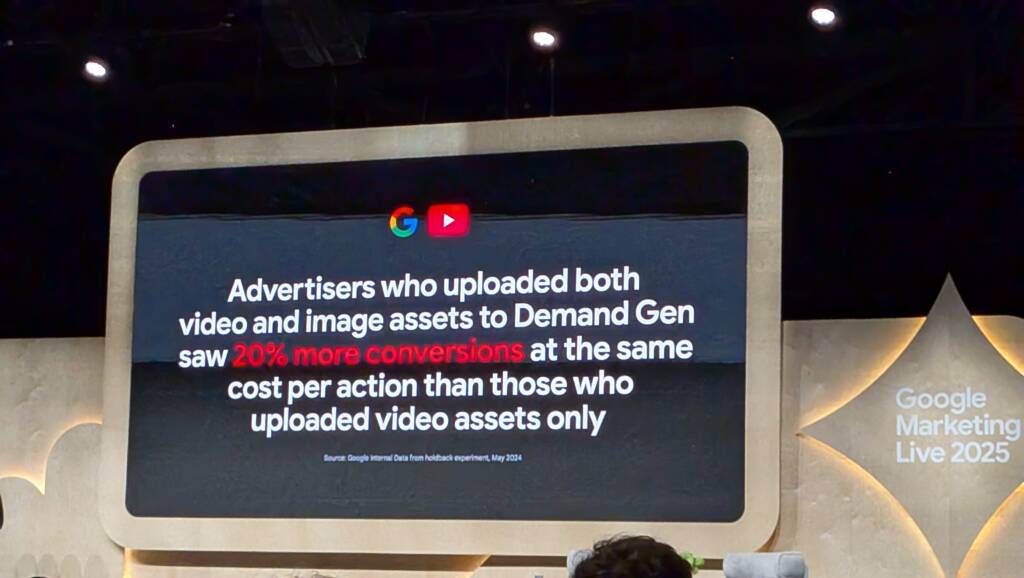


As expected, AI was the headline act. Google is leaning heavily into its positioning as having the best AI for the best ROI, and much of the day was focused on what that means practically for advertisers, platforms, and the future of search.
“The latest updates from Google Marketing Live 2025 highlight a future where marketers can harness AI to reach audiences at every stage of the journey, delivering more relevant, personalised, and measurable results than ever before.”
— Brendan Christie, Head of Search
Here’s a summary of the key takeaways that are most relevant to our work and our clients.
AI Is Already Changing Search (and Everything Around It)
New product releases—Gemini 2.5, Veo 3, and Waymo—are now live. More importantly, Google reinforced that they’re taking a measured, responsible approach to AI. Their pitch isn’t about being first; it’s about doing it well and in a way that keeps user trust front and centre.
Search, YouTube, Shopping—every channel is being reshaped by AI.
People Don’t Move in Funnels Anymore

One of the big reminders was how non-linear the customer journey has become. Google outlined that users bounce between:
Streaming
Scrolling
Shopping
Searching
Some useful data:
65% of journeys start on Google or YouTube, even when social is involved
70% of people use Google to evaluate products they discovered on social
Gen Z (18–24) are heavy users of Google Lens—visual search is growing fast
In total, Google handles over 5 trillion searches per year, and 20 billion Lens searches a month. That’s a lot of real-time intent signals.
AI Mode: Personalised, Contextual Search
AI Mode is already live in the US and will continue to roll out globally. It’s a more natural, contextual way to search, and Google is building it to understand why someone is searching—not just what they typed in.
Some key features:
AI Mode queries are 2–3x longer
It can personalise responses (with Gmail syncing via “Personal Context”)
Ads will be included in AI Mode and AI Overviews, with Overviews expected to land in Australia this year
It’s more than just a different look for the SERPs—it’s a shift in how commercial intent is understood and responded to. Basically, AI-powered responses that:
Include images
Offer follow-up questions
Show ads aligned with inferred commercial outcomes
Example they used:
If someone searches “how to get dogs on flights in the US,” the AI might explain airline policies and serve ads for dog carriers, anticipating what the person likely needs next. It’s a more intuitive ad experience that connects informational searches to practical actions.
AI Maturity Across Organisations
According to BCG’s research into AI maturity:
First, companies need to get their data right. Without a unified customer view, AI has nothing to work with (the old adage, garbage in is garbage out).
Whilst doing this, use AI to accelerate creative development—concept ideation, asset generation, and rapid testing can all be supercharged
This isn’t about replacing strategy with automation. It’s about using AI to do what you’re already doing—better and faster.
To operationalise this:
Know your starting point
Identify high-impact opportunities nearby
Set 1–2 quarterly goals to make short-term incremental change
Build a team that’s aligned in mindset and skillset
Performance Tools: What’s Available Now (The “Power Pack”)
Three key tools were highlighted as core to Google’s performance stack in 2025: